Existential Journeys and Making Peace With the Chaos of Humanity

Barbie and Asteroid City, two of the best (or my favorite) films to come out last year, don’t have a ton in common, besides their bright colors and usage of Margot Robbie. They each explore many themes, individually, but I think they have some crossover in their examination of what it means to be alive. How do we live? Why do we live? What do we do it for? What’s the meaning? What’s the purpose?
Barbie answers this question with a beautiful montage illustrating the depth of humanity, and by having Barbie go on a journey to realize that to be human means having the ability to create, to be a part of something bigger than yourself, and to accept the feelings as they come. Barbie’s experiences leave her in a place in which she cannot do anything except to choose to be human and to live in the real world amongst all the trials and tribulations. The authenticity of human connection and of family and friendship becomes something she can’t just leave behind.
After being catcalled and assaulted and arrested and harassed and chased through Los Angeles, it would seem like Barbie would’ve had enough of the real world. What makes her choice so special is that even through all the muck, she sees what matters– the smile she shared with the woman on the bench, the people she watched talking and laughing together, her interactions with Sasha and her mom, joining together with the her human friends and fellow Barbies to fight for their rights, and the joy of being a woman. After returning to Barbieland, even when things are straightened out with the Kens, something feels off. She doesn’t feel like she belongs there anymore–because she doesn’t. To be human is to be around people, and to learn from them, to grow. Her experiences with her human friends went far below the surface of her plastic doll body, and once she started to see how much life had to offer, she couldn’t go back. The purpose of life is just that: to live. There’s nothing to be attained, no huge task that needs to be completed. There’s no goals involved. To Greta Gerwig, living and breathing and moving and learning and loving–that’s the meaning of life.

Asteroid City answers the question a little differently. In the scene near the end, in which Jason Schwartzman’s character, who is an actor, walks off of the set and speaks to his director Schubert Green, played by Adrien Brody, he expresses the toll that playing his character has taken on him. He worries that he isn’t portraying the character right, and the director responds by looking him in the eyes, and telling him that he is playing his part “perfectly.” Schwartzman’s character fears that even after weeks of rehearsals, he still doesn’t understand the play he’s in. Green looks at him sincerely, and says, “It doesn’t matter. Just keep telling the story.”
I think that line alone makes it clear how Wes Anderson himself feels about art, and life itself. We live in a truly bizarre world, something that Anderson has fun highlighting and manipulating in his work. There’s no way to see what will come next, there’s no way to rationalize every single situation one could find themselves in. But that doesn’t matter. The only way to live is to keep going. There’s no right or wrong way to do it. Just by living, or “telling the story,” we are doing it right–whether we understand what’s happening, what’s to come, or not. There is no other way to live than to do just that: live.
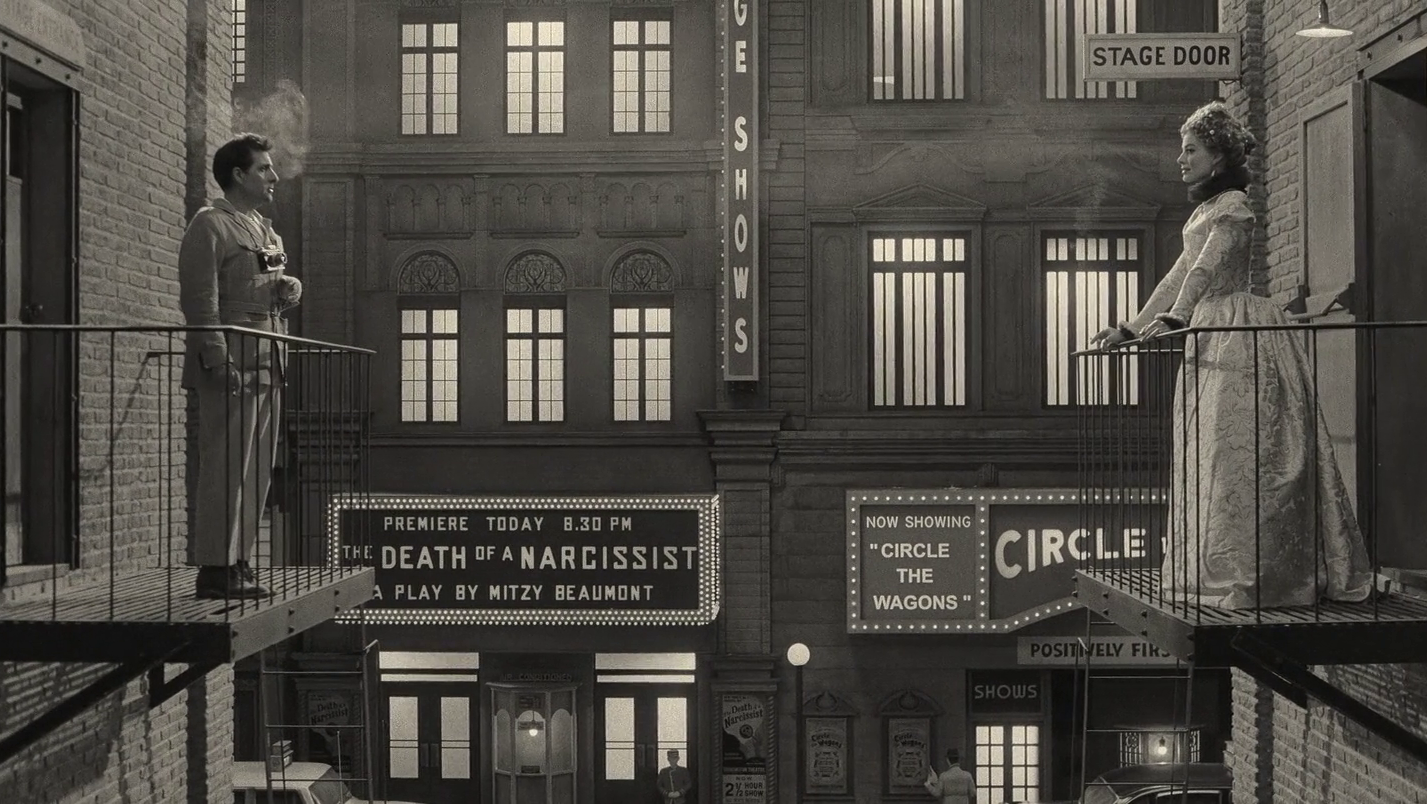
After that scene, Schwartzman’s character heads out to the balcony, where he sees the actress who originally played his wife, portrayed by Margot Robbie, before her part was cut for time. She walks him through the scene they were supposed to share, and while she recites the lines for both of their parts, he stares at her in awe. Anderson shoots the entire scene from the side, until it cuts to a close-up on her as she, referring to the photograph his character would’ve taken, says, “I hope it comes out.” He remembers his last line of the scene–”All my pictures come out.” The scene is infused with an emotional tension that grounds the entire film, and between the interaction between Schwartzman’s character with the director and with the actress, is one of the most impactful sequences of all of Anderson’s works.
Both Gerwig and Anderson seem to convey that when it comes to living life or creating art, it’s all really about who you share it with. There is an inherent loveliness to the sentiment, as the complex layers of humanity are peeled back until we see what’s underneath: a desire to feel, to know, to be known, to love and be loved. Something else I love about these two films is the absurdist lengths they go to to communicate these ideas: a talking doll who learns to breathe, an alien who takes an asteroid only to return it.
The final few scenes of Barbie, where she realizes she doesn’t feel like “Barbie” anymore, show some of the rawest human feelings. As Barbie comforts Ken, she tells him, “maybe everything you thought made you “you” isn’t really you.” She realizes while saying it that she’s talking to herself, too. She’s been telling herself and everyone the whole film that she’s “stereotypical” Barbie, she downplays her intelligence and strength, and she tries to wish her problems away instead of fixing them herself. But in connecting with humanity, in her desire to “do the imagining” and no longer “be the idea,” she realizes that even with all of the pain and stress and patriarchy of the real world, she doesn’t want to go through the motions anymore. To her, any amount of pain and even the future reality of death is all worth getting to live a life where she can “be a part of the people who make meaning.”
The last scene of the Asteroid City, before the epilogue, consists of a theater class in which every cast member at some point stands and says “You can’t wake up if you don’t fall asleep.” This turns into a chant, which is repeated as the alien from the film walks into frame. Anderson loves playing with absurdity, but to me, “waking up” might refer to the act of creating. A new day, a new canvas, a blank page–the world at your fingertips, making art, moving through life without a weight holding you down. However, falling asleep could mean losing control. To become one with the inner demons we try to hide from, or to go through painful experiences–things that we desperately want to avoid, but can’t. It’s those very experiences that allow us to later enjoy the positive aspects of life, and to have the ability to turn that pain into something we can use–a force for good. The good days can’t happen without the bad.

Thematically, Barbie and Asteroid City twist and turn and overlap and converge like two very colorful snakes. The films are very different in many ways, but at the core is something that is so genuine and honest. I think that’s what attracted me to these films, and what kept me going back again and again. I ended up seeing Asteroid City 7 times in theaters, and if you think that’s a lot, I saw Barbie 18 times in theaters (and 4 more since it came out on streaming). Sitting in a dark room with a huge crowd of strangers as we all went on a journey of discovering ourselves and thereby discovering the meaning of life was priceless to me. The summer of 2023 brought me a lot of struggles and pain, but it also brought me beautiful cinema that took hold of my heart and helped me open my eyes. This definitely isn’t the last time I’ll be talking about Barbie or a Wes Anderson film on here, so if you’re interested in more thematic analysis pieces like this let me know. ❤
 “guess i'll see you in the movies”
Leave a comment